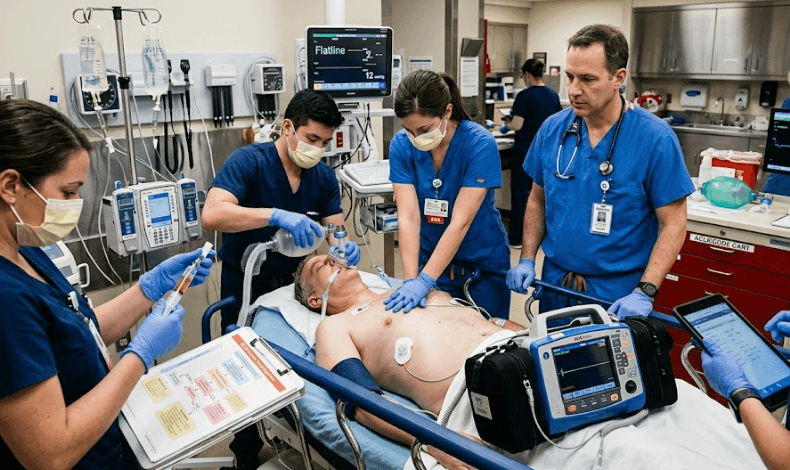
ACLS Exam Preparation: What Actually Works in Real Life
If you ask clinicians what they find most challenging about the ACLS exam, the answers vary, but the underlying issue is often the same. It is not a lack of knowledge, but rather how that knowledge is applied under pressure. The exam is designed to reflect real clinical situations, where decisions must be made quickly and with confidence. In that sense, ACLS is less about memorising algorithms and more about developing a structured way of thinking when a patient is critically unwell.
At its core, ACLS is governed by one principle: time is critical. In cardiac arrest, outcomes are determined within minutes, sometimes seconds. Candidates who perform well understand that perfection is not required; what matters is timely and appropriate action. Starting high-quality cardiopulmonary resuscitation without delay, identifying the cardiac rhythm promptly, and delivering defibrillation when indicated are the interventions that consistently make a difference. The difficulty arises when candidates hesitate, often because they are trying to recall entire algorithms instead of focusing on the immediate next step.
A practical way to approach any ACLS scenario is to ask a simple question: what action will most likely improve the patient’s outcome in the next few seconds? This mindset shifts attention away from theoretical knowledge and towards clinical priorities. It also mirrors how experienced clinicians operate in real resuscitation settings, where decisions are made sequentially rather than as part of a memorised script.
One of the most effective ways to simplify ACLS preparation is to reduce rhythm recognition to its essential purpose. The key distinction is not between dozens of ECG patterns, but between shockable and non-shockable rhythms. Ventricular fibrillation and pulseless ventricular tachycardia require immediate defibrillation, whereas asystole and pulseless electrical activity do not. Once this distinction is clear, the rest of the management pathway becomes far easier to navigate. Candidates who struggle often attempt to interpret rhythms in excessive detail, losing valuable time and confidence in the process.
The cardiac arrest algorithm, which many candidates find intimidating, becomes manageable when broken down into decision points rather than memorised as a continuous flowchart. The process begins with recognising cardiac arrest and initiating high-quality CPR. The next critical step is rhythm assessment, which determines whether defibrillation is required. From there, management follows a logical sequence based on the patient’s response and the persistence of the arrest. This approach reflects clinical reality more closely than rigid memorisation and allows for more flexible thinking during the exam.
Medication use in ACLS is another area that frequently causes confusion, particularly regarding timing. Epinephrine and amiodarone are not simply administered according to a schedule; their use depends on the clinical context. In shockable rhythms, defibrillation takes priority, and medications are introduced only after initial attempts at electrical correction. In non-shockable rhythms, pharmacological support becomes more important early in the resuscitation. Candidates who understand the reasoning behind these choices are far less likely to make errors than those who rely solely on memorised sequences.
Equally important, though often underestimated, is the role of reversible causes of cardiac arrest. The so-called Hs and Ts are not merely a list to recall during the exam, but a framework for identifying underlying problems that can be corrected. In practice, recognising these causes requires attention to clinical clues within the scenario. A patient with chest pain prior to collapse may suggest coronary thrombosis, whereas a trauma patient may point towards hypovolaemia or tension pneumothorax. Integrating this reasoning into ACLS preparation enhances both exam performance and clinical competence.
Airway management and ventilation, while sometimes treated as secondary considerations, also play a significant role. Candidates must demonstrate an understanding of how to provide effective ventilation without compromising chest compressions. Once an advanced airway is established, the approach changes, requiring continuous compressions and controlled ventilation. Errors in this area are often subtle but can affect overall performance in the exam.
In recent years, greater emphasis has been placed on post–cardiac arrest care. The period following return of spontaneous circulation is critical, and management focuses on stabilising the patient, optimising oxygenation, and preventing further injury. This reflects an evolution in resuscitation science, recognising that survival depends not only on immediate interventions but also on what happens afterwards.
When examining how successful candidates prepare, certain patterns emerge. They tend to focus on clinical scenarios rather than passive reading, engaging with questions that simulate real decision-making. They prioritise understanding over memorisation and practice under time constraints to improve both speed and accuracy. Perhaps most importantly, they review their mistakes carefully, using them as an opportunity to refine their thinking.
Common errors in the ACLS exam are rarely due to lack of effort. More often, they result from delays in recognising shockable rhythms, incorrect timing of medications, or failure to consider reversible causes. These mistakes can be avoided by adopting a structured and practical approach to preparation.
Ultimately, ACLS should not be viewed solely as an exam to be passed. It represents a set of skills that have direct implications for patient survival. Candidates who approach it with this perspective tend to perform better, not only in the exam but also in clinical practice. The goal is not simply to recall an algorithm, but to respond effectively when it matters most.